
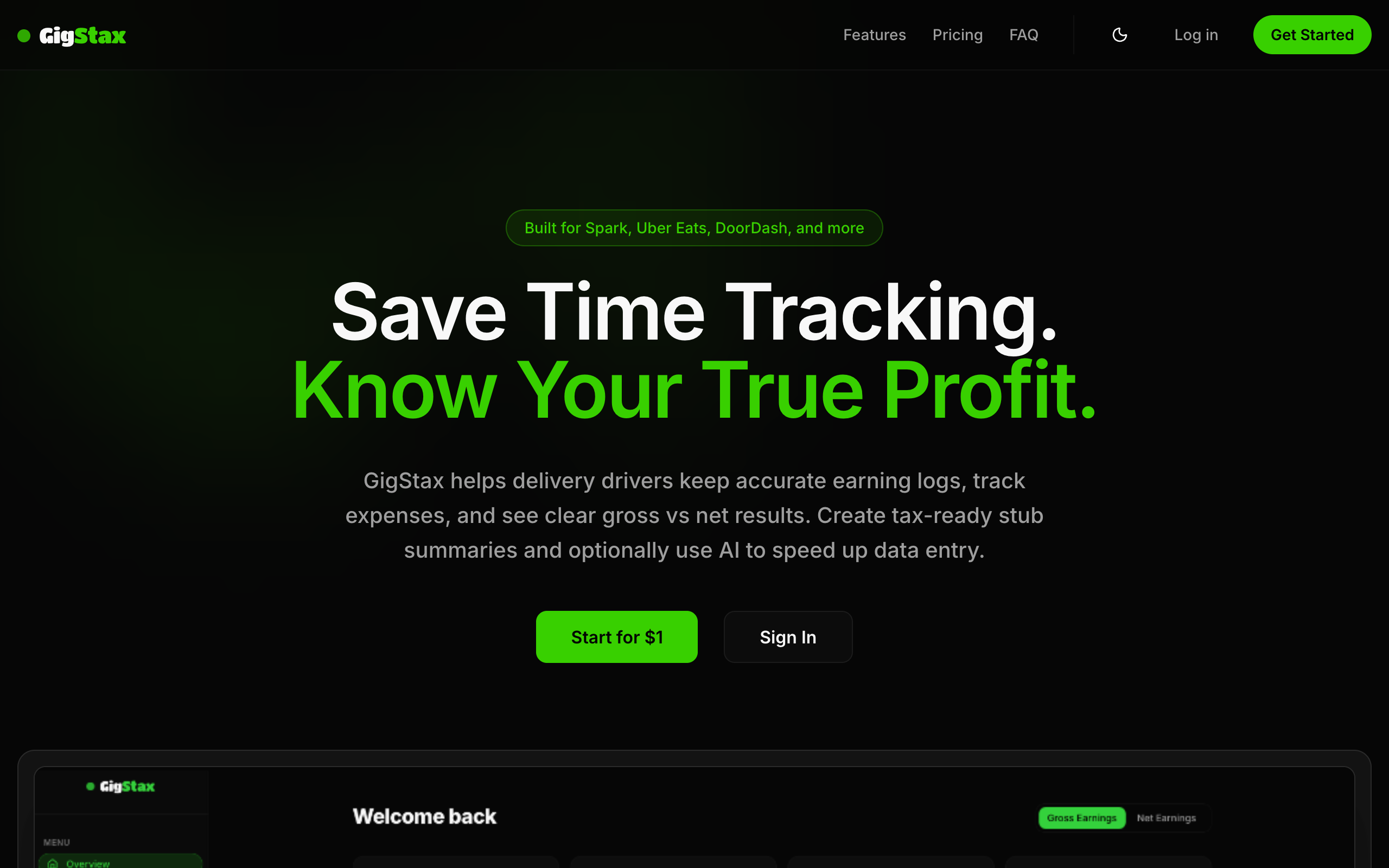
GigStax
Finance operating tool for gig workers featuring durable receipt and screenshot AI extraction on Cloudflare Workflows.
GigStax (Earnings Tracker)
GigStax is a full-stack earnings and expense tracker built for gig delivery drivers. It combines manual entry, AI-assisted extraction from screenshots/receipts, and tax-ready income stubs inside a subscription-based dashboard. The app targets multi-platform drivers (Spark, Uber Eats, DoorDash, Instacart, and more) and focuses on clear gross vs net visibility, platform-level breakdowns, and historical reporting.
This is the Cloudflare edition of the app, ported from the original Next.js/Vercel codebase: TanStack Start on Cloudflare Workers, a Hono API, Drizzle + Postgres on PlanetScale (provisioned by Alchemy), Cloudflare Workflows for the AI extraction pipeline, R2 for media, and Polar for billing.
Tech Stack
- TanStack Start (SSR) with React 19 and TypeScript on Cloudflare Workers.
- Hono API (stoker +
@hono/zod-openapiroute style, OpenAPI doc at/openapi). - Cloudflare Workers runtime —
gigstax-web(web) andgigstax-server(API) workers. - Drizzle ORM with Postgres, hosted on PlanetScale Postgres (Alchemy-provisioned).
- Alchemy for infrastructure-as-code (Workers, D1-free stack: PlanetScale, R2, Axiom, Workflows).
- Better Auth (email/password + Google OAuth) with the Drizzle adapter, Polar checkout/portal plugins, and the Expo plugin for the upcoming mobile app.
- Cloudflare Workflows — durable, step-retried extraction pipeline.
- R2 for private media storage, streamed through ownership-checked API routes.
- Vercel AI SDK + Gemini 3 Flash for screenshot and receipt extraction.
- Tailwind CSS v4 with Radix UI primitives (shared via
packages/ui). - TanStack Query for client data fetching, Recharts for visualizations.
- Resend for transactional + lifecycle email, with lifecycle jobs on a CRON_SECRET-protected endpoint.
- evlog → Axiom for structured logging and observability.
- oxlint + Oxfmt via Ultracite for linting and formatting, Vitest for unit tests.
Product Summary
GigStax helps drivers log deliveries, track expenses, and understand profitability across multiple gig apps. The onboarding flow collects platform selections, time zone, and weekly cadence, then the dashboard surfaces totals, charts, and recent activity. AI workflows parse screenshots and receipts into structured entries, and bulk upload queues multiple files for durable background processing. The billing system supports subscription tiers, metered usage, and one-off credit packs through Polar. Email notifications are delivered via Resend, and admin tools provide pricing/usage management.
Core Features
- Delivery earnings tracking with platform, status, miles, duration, stops, base pay, bonus, and tip states.
- Expense logging with categories (fuel, tolls, maintenance, supplies, phone, and more) plus receipt attachments.
- AI extraction from single screenshots and receipts using the AI SDK + Gemini 3 Flash.
- Bulk upload pipeline that queues multiple images into Cloudflare Workflows with per-item status polling and retry.
- Weekly goals dashboard with charts showing base pay and tips by day.
- Income stubs with configurable cadence (weekly, biweekly, monthly), YTD totals, printable views, and CSV/PDF exports.
- Platform management with default options plus custom platform creation and color assignments.
- Notifications for pending tip verification after a delay window.
- Subscription billing, usage metering, and credit packs via Polar, surfaced through a
/api/billingentitlement aggregate. - Admin suite for user counts, pricing plan edits, credit packs, discounts, and usage analytics.
- Private media storage in R2 and secure retrieval through gated API routes.
Key Pages and Routes
/marketing home with pricing and feature highlights./signupand/loginauthentication (email/password + Google OAuth)./onboardingsetup wizard for profile, platforms, and plan selection./dashboardsummary view with gross/net toggles, charts, and recent entries (singleGET /api/dashboardaggregate)./dashboard/deliveriesdelivery entry list with AI/bulk workflows./dashboard/deliveries/[id]delivery detail, edit, and screenshot view./dashboard/expensesexpense list with receipt uploads and bulk extraction./dashboard/expenses/[id]expense detail and edit./dashboard/goalsweekly targets and progress visualization./dashboard/stubsincome stub dashboard, history, and cadence settings./dashboard/stubs/[id]stub detail and/printview./dashboard/notificationspending tip verification queue./dashboard/settingsprofile, timezone, platform selection, and verification info./dashboard/billingsubscription management, consumed vs included credits, pack balance, and credit-pack purchases./dashboard/adminadmin overview with links to user, pricing, and usage tools.
API Surface (Selected)
Auth and session
GET|POST /api/auth/*Better Auth handler (mounted from the Hono app).GET /api/useruser profile, selected platforms, verification profile.PATCH /api/userupdate timezone, week start, platforms, verification profile.
Dashboard
GET /api/dashboardaggregated dashboard data (1:1 port ofgetDashboardData).
Entries
GET /api/entrieslist entries with filters, pagination, and summary.POST /api/entriescreate a manual delivery entry.GET|PATCH|DELETE /api/entries/{id}fetch, update, or delete an entry.POST /api/analyze-imageAI analysis for a screenshot or receipt.POST /api/analyze-screenshotAI analysis (legacy screenshot endpoint).POST /api/entries/bulk-analyzequeue bulk delivery screenshot analysis.GET /api/entries/bulk-analyze/statuspoll bulk extraction status.POST /api/entries/bulk-analyze/retryretry failed extractions (new Workflow instances).PUT /api/entries/{id}/trip-verificationstore trip verification data.GET /api/entries/trip-verification-queueentries needing verification input.
Expenses
GET|POST /api/expenseslist expenses with filters and summary / create expenses.GET|DELETE /api/expenses/{id}expense detail and delete.POST /api/expenses/{id}/mediaattach receipt media.POST /api/expenses/bulk-analyze(+/status,/retry) bulk receipt analysis.
Billing
GET /api/billingsubscription row + entitlement + active pricing plans + active credit packs.
Stubs
GET /api/stubslist stub history and defaults.POST /api/stubs/previewpreview a stub snapshot.POST /api/stubscreate a new stub.GET|PATCH /api/stubs/{id}fetch or update stub status/fields;POST .../lock,GET .../csv,GET .../pdf.
Platforms and onboarding
GET|POST /api/platformsplatform options and custom platform creation.GET /api/onboardingonboarding state (user, platforms, pricing).POST /api/onboardingsave onboarding selections.
Admin
GET /api/admin/overview,GET /api/admin/users,PATCH /api/admin/users/{id}/role.GET|POST|PATCH /api/admin/pricing/plans,/packs,/discounts(+ expire),POST /api/admin/pricing/sync,GET /api/admin/pricing/offer,GET /api/admin/usage/summary.
Media, email, and jobs
GET|DELETE /api/media/{id}stream or delete private media (R2, ownership-checked).GET|PATCH /api/email/preferences,POST /api/email/unsubscribe,GET /api/u/unsubscribe(public one-click, token-based).POST /api/webhooks/resendResend webhook (svix-verified).GET /api/cron/email-lifecyclelifecycle email pass (Bearer CRON_SECRET).GET /openapiOpenAPI 3.1 document for the whole API.
Monorepo Architecture
apps/webTanStack Start app — routes, components, hooks (client side of the ported product).apps/serverHono API on Cloudflare Workers — route modules (src/routes), ported services (src/lib/services), emails (src/emails), and theProcessExtractionWorkflowCloudflare Workflow.apps/nativeExpo + UniWind app shell (better-auth Expo client wired; screens are next up).packages/dbDrizzle schema + generated migrations (postgres dialect for PlanetScale).packages/authshared better-auth factory (web + native), Polar plugins, Google OAuth.packages/uishared shadcn/ui primitives and the GigStax theme tokens.packages/infraAlchemy stack (alchemy.run.ts) — Workers, PlanetScale database, R2 bucket, Axiom dataset, Workflow binding.packages/configshared tsconfig/oxlint presets.
Data Model Highlights
Core authentication
user,session,account,verificationfrom Better Auth.
App domain
usersapp-level user profile and settings.platformssystem + custom gig platforms.user_platformsper-user platform selections and colors.earnings_entriesdelivery income logs.expensesbusiness expense logs.media_assetsstored screenshots and receipts.entry_mediaandexpense_mediamedia relationships.ai_extractionsqueued/completed AI parsing results (with Workflow instance ids inworkflow_run_id).entry_trip_verificationstrip mileage verification records.
Billing and usage
pricing_planssubscription tiers and feature limits.credit_packsone-off AI credit bundles.user_credit_balancesrolling credit pack usage.credit_transactionscredit consumption ledger.subscriptionsper-user plan tier and billing interval.billing_metersPolar metering IDs.ai_usage_eventsAI and bulk usage audit records.
Income stubs
stub_profilesper-user stub preferences and verification info.income_stubsgenerated stub snapshots and history.
Email tracking
email_eventsidempotent transactional and lifecycle email tracking.email_preferencesper-user lifecycle email preferences.email_suppressionssuppression list for bounce/complaint/unsubscribe handling.email_webhook_eventsidempotent webhook event ingestion.
AI Extraction Pipeline
- User uploads a screenshot or receipt.
- The file is stored in R2 (private) and a
media_assetsrecord is created. - A
ProcessExtractionWorkflowinstance is created (durable, step-retried Cloudflare Workflow) with an idempotency key; the instance id is stored on the extraction row. - The
analyze-mediastep reads the object bytes from R2 (legacy Vercel Blob records still work via their providers) and calls Gemini 3 Flash via the AI SDK, with exponential retries. - Parsed payload is normalized into standardized fields (entry vs expense), usage recorded in
ai_usage_events, and optionally metered through Polar. - Bulk uploads create one Workflow instance per file; status is polled via API and retries spawn fresh instances.
Billing and Entitlements
GigStax uses Polar for checkout and subscription management. Entitlements are derived from pricing plans and usage meters and exposed via GET /api/billing.
Default pricing tiers (from code-defined catalog)
- Starter Monthly: 10 AI credits, manual entry, receipt attachment.
- Driver Monthly: 300 AI credits, bulk uploads, mid-level analytics.
- Driver Yearly: same limits with yearly billing.
- Pro Driver Monthly: unlimited AI and bulk workflows, full analytics and exports.
- Pro Driver Yearly: same limits with yearly billing.
Credit packs
- Optional one-time AI packs provide extra credits for users on capped plans.
Authentication and Authorization
- Better Auth provides email/password and (when
GOOGLE_CLIENT_ID/GOOGLE_CLIENT_SECRETare set) Google OAuth. - Sessions are persisted in Postgres through Drizzle; cookies use
SameSite=None; Secureso the API (gigstax-server) serves both the web app and the future native app. - App roles are derived from the
ADMIN_EMAILSallowlist; app-user rows are upserted lazily on first session resolution. - Route guards enforce authentication, onboarding completion, and admin access.
Media Storage
- New uploads target a private R2 bucket (the
MEDIAbinding, Alchemy-provisioned). - Legacy Vercel Blob records remain readable through provider-aware logic (bring your blob tokens if you have existing data).
- Media is fetched through
/api/media/{id}, which validates user ownership and streams bytes with ETag/304 support.
Observability
- evlog middleware assigns request context and ships logs to an auto-provisioned Axiom dataset (
gigstaxcf-<stage>-logs). - A service-level pino-compatible shim covers module-level logging.
Local Development
Prerequisites: Bun, and accounts on Cloudflare, PlanetScale, and Axiom (all managed by Alchemy).
bun install

# one-time: authenticate the providers Alchemy will use
bunx alchemy login cloudflare
bunx alchemy login planetscale
bunx alchemy login axiom

bun run dev
- Web app: http://localhost:3001
- API: http://localhost:3000
- Native shell: update
apps/native/.envwith your LAN IP (EXPO_PUBLIC_SERVER_URL=http://<YOUR_LOCAL_IP>:3000)
Alchemy provisions PlanetScale, injects its connection credentials, and applies checked-in migrations during deploy. Generate migration SQL with bun run db:generate.
The generated PlanetScale database uses the PS_DEV size, which may incur usage charges — adjust clusterSize in packages/infra/alchemy.run.ts before deployment if needed.
Deployment
The stack deploys two workers on your Cloudflare account:
| Worker | URL |
|---|---|
| Web (TanStack Start) | https://gigstax-web.rocktown-labs.workers.dev |
| API (Hono) | https://gigstax-server.rocktown-labs.workers.dev |
# before the first deploy, point the API at the deployed web origin
# (local dev keeps http://localhost:3001)
CORS_ORIGIN=https://gigstax-web.rocktown-labs.workers.dev
POLAR_SUCCESS_URL=https://gigstax-web.rocktown-labs.workers.dev/success?checkout_id={CHECKOUT_ID}
SITE_URL=https://gigstax-web.rocktown-labs.workers.dev

bun run deploy
bun run deploy runs Alchemy from packages/infra: it provisions the PlanetScale database (+ role), the R2 media bucket, the Axiom dataset + ingest token, both Workers (with the MEDIA and PROCESS_EXTRACTION bindings), applies migrations, and returns the worker URLs. bun run destroy tears the stack down.
Notes
- The same
apps/server/.envfeeds both local dev and deploy — flipCORS_ORIGIN(and the other web-origin URLs) to the workers.dev origin when deploying, and back for local dev (or export them in CI). - With a custom domain later, update
CORS_ORIGIN/POLAR_SUCCESS_URL/SITE_URLand add the domain to the Alchemy Worker config; workers.dev names stay as fallbacks.
Scripts
| Command | Purpose |
|---|---|
bun run dev |
Start the full dev stack (web :3001, API :3000). |
bun run build |
Production builds across the monorepo (Turbo). |
bun run check-types |
TypeScript checks for all workspaces. |
bun run check |
Ultracite (oxlint + oxfmt) check. |
bun run fix |
Auto-fix lint and formatting. |
bun run test |
Vitest unit tests (server + web) via Turbo. |
bun run db:generate |
Generate Drizzle migrations from the schema. |
bun run deploy |
Alchemy deploy (Cloudflare + PlanetScale + Axiom). |
bun run destroy |
Alchemy destroy (tears down the stack). |
bun run env:generate |
Regenerate Varlock env typings after schema changes. |
Testing
- Unit tests live in
apps/server/tests/unit(services, validations, pdf builder, email rendering, entitlements, polar config, etc.) andapps/web/tests(component tests) — run withbun run test. - The old live-database integration suite (Next route handler tests) is not ported yet; the ported route modules are exercised via their OpenAPI definitions and the smoke-tested Hono dispatch.
Environment Variables
Deployed values are declared in packages/infra/alchemy.run.ts (all optional ones default to empty). Local dev values live in each app's .env (see .env.schema).
| Variable | Where | Purpose |
|---|---|---|
DATABASE_URL |
Alchemy-injected | PlanetScale pooled connection (auto; do not set manually). |
BETTER_AUTH_SECRET |
server | Auth cookie signing secret (required). |
BETTER_AUTH_URL |
auto | Worker URL (set by Alchemy). |
CORS_ORIGIN |
server | Trusted web origin (required; web workers.dev URL in deploy). |
GOOGLE_CLIENT_ID / GOOGLE_CLIENT_SECRET |
server | Enable Google OAuth. |
GOOGLE_GENERATIVE_AI_API_KEY |
server | Gemini 3 Flash for screenshot/receipt extraction. |
ADMIN_EMAILS |
server | Comma-separated admin allowlist. |
POLAR_ACCESS_TOKEN |
server | Polar API token for checkout, portal, subscriptions (required). |
POLAR_SUCCESS_URL |
server | Checkout success redirect (web origin + /success). |
POLAR_SERVER |
server | sandbox or production. |
POLAR_ORGANIZATION_ID |
server | Required only for non-org Polar tokens. |
POLAR_*_PRODUCT_ID |
server | Polar product UUIDs per plan (Starter/Driver/Pro, monthly/yearly). |
POLAR_AI_EXTRACT_METER_ID / POLAR_BULK_UPLOAD_METER_ID |
server | Polar metering IDs. |
RESEND_API_KEY |
server | Transactional + lifecycle email. |
RESEND_FROM_TRANSACTIONAL / RESEND_FROM_LIFECYCLE |
server | From addresses per email category. |
RESEND_WEBHOOK_SECRET |
server | Svix secret for Resend webhook verification. |
EMAIL_UNSUBSCRIBE_SECRET |
server | HMAC secret for signed unsubscribe links. |
CRON_SECRET |
server | Bearer token for /api/cron/email-lifecycle. |
SITE_URL / NEXT_PUBLIC_APP_URL / NEXT_PUBLIC_SITE_URL |
server | Public web origin used in email links (fallbacks). |
RADAR_SERVER_KEY / NEXT_PUBLIC_RADAR_PUBLISHABLE_KEY |
server + web | Radar geocoding/routing for trip verification. |
AI_INPUT_COST_PER_1M / AI_OUTPUT_COST_PER_1M |
server | Override token cost estimates for AI usage. |
BLOB_PRIVATE_READ_WRITE_TOKEN / BLOB_READ_WRITE_TOKEN |
server | Legacy Vercel Blob reads for existing media. |
VITE_SERVER_URL |
web | API origin (Alchemy-injected; localhost for dev). |
EXPO_PUBLIC_SERVER_URL |
native | API origin for the Expo app. |
Notes
- The web app is a client-heavy TanStack Start port of the original Next.js app; all routes keep their original paths and URL contracts.
- The API uses stoker +
@hono/zod-openapiconventions: typed status codes,defaultHook422 validation responses, and a generated OpenAPI document at/openapi. - Background processing runs on Cloudflare Workflows with durable, step-retried steps and instance ids tracked on extraction rows.
- Billing and entitlements are first-class in the data model (subscriptions, credit packs, meters) and are surfaced through a single
/api/billingaggregate.